Co-Working vs Traditional Office: Pros, Cons and How to Decide
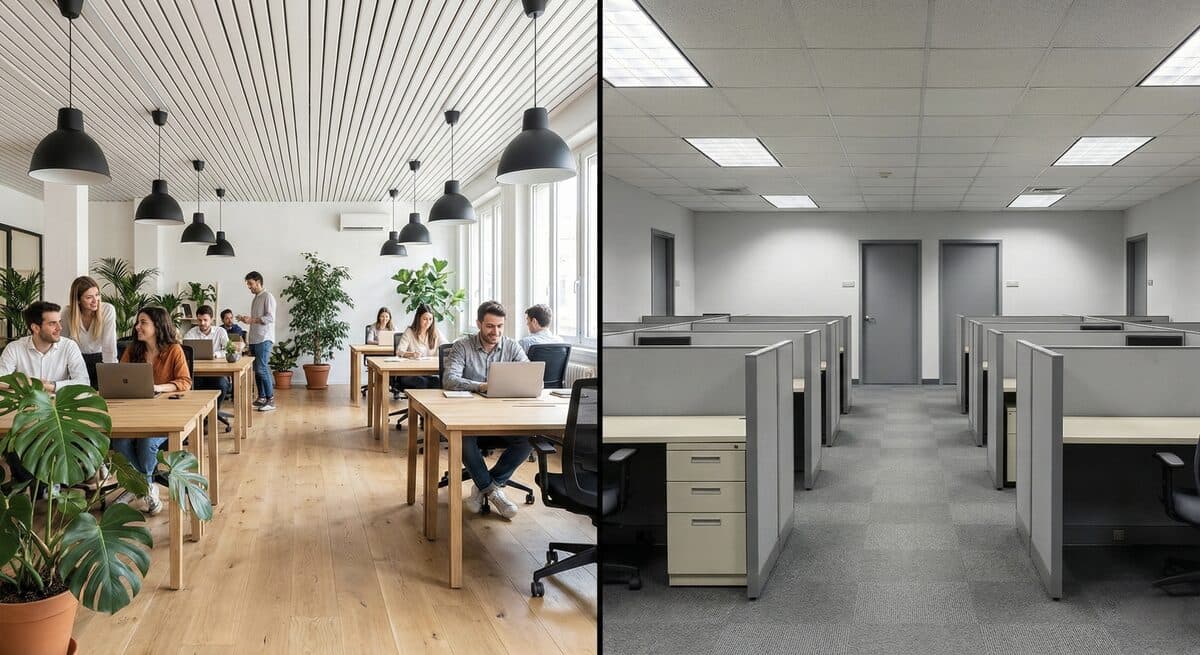
Co-Working vs Traditional Office: Pros, Cons and How to Decide
The choice between co-working and a traditional office isn't trivial. Both options have real advantages, and the right choice depends on your specific situation — not on what's trendy. In this article, we analyze the pros and cons of each solution honestly, without bias, to help you decide with clarity.
Costs: The Real Comparison
A traditional office has high fixed costs that are mostly predictable, but with many hidden line items. Rent is just the beginning: utilities, cleaning, insurance, maintenance, initial furniture, internet, security deposit. In a city like Viareggio, the total monthly cost for a small office (40-60 sqm) easily reaches €1,000-2,000 per month.
Co-working has an all-inclusive monthly cost. A dedicated desk starts at €250-400, a private office at €400-1,000. No upfront investment, no separate bills.
Co-working wins for lower costs and predictability, especially for freelancers and small teams. A traditional office can be more cost-effective for larger teams (10+ people) where the per-desk cost decreases.
Flexibility
A traditional office requires 6+6 year leases (standard in Italy), with 6-12 month notice periods. Changing size means finding new space, moving, new utility connections. Co-working offers monthly contracts, quick upgrade and downgrade options, and no long-term commitments.
Co-working wins decisively. For startups, freelancers, and rapidly growing companies, flexibility is a competitive advantage.
Privacy and Customization
A traditional office is your space: you furnish it as you want, organize it as you prefer, put your brand everywhere. Co-working — even with a private office — is still a shared space with rules and customization limits.
Traditional office wins for those with specific layout needs, intensive branding, or absolute confidentiality requirements. But private offices in modern co-working spaces offer good customization levels, including branding on the door.
Productivity
This depends heavily on the individual. A traditional office offers total environmental control: silence when you want it, music when you want it, no strangers. Co-working offers an environment designed for productivity — but shared with others, which can be stimulating or distracting depending on the person.
It depends. If you need absolute silence and total control, traditional office wins. If you draw energy from other professionals' presence and need structure to be productive, co-working wins.
Networking and Community
A traditional office isolates you. You're surrounded by the same people every day — your team, your colleagues. External networking opportunities are limited to events and conferences. Co-working puts you in daily contact with professionals from different sectors. Connections arise naturally, without forcing.
Co-working wins significantly. For freelancers and small businesses, organic networking is one of the most underrated and valuable advantages.
Professional Image
Your own office in a good location communicates solidity and investment. But a modern, well-designed co-working also communicates professionalism — often more so, because the design and space care in a good co-working exceed what most small businesses can afford in their own office.
Tie. Depends on the quality of the specific space. A design co-working beats a generic office; a polished office beats an improvised co-working.
Operational Management
A traditional office requires management: cleaning, maintenance, suppliers, technical issues, contract renewals. All time and energy taken from work. Co-working handles everything for you.
Co-working wins. Time is the scarcest resource for professionals and entrepreneurs. Not having to manage office operations has enormous value.
When to Choose a Traditional Office
A traditional office is the right choice if you have a stable team of 10+ with specific layout needs, if you work in a sector with particular regulatory requirements (medical practices, laboratories), if you need absolute confidentiality due to the nature of your work, or if you already own property or have an advantageous long-term contract.
When to Choose Co-Working
Co-working is the right choice if you're a freelancer or small team (1-8 people), if your company is growing and you don't yet know how much space you'll need in a year, if you want to avoid the upfront investment and hidden costs of a traditional office, if networking and community are important for your business, or if you want to focus on work rather than office management.
The Third Way: The Hybrid Model
More and more companies are adopting a hybrid approach. The typical example: a company has a small operational office for the core team and uses a co-working for additional workstations, meeting rooms, and events. Or a professional has their own studio for receiving clients and uses co-working as a work base for operational days.
Altrove supports this model by offering flexible plans that integrate with spaces you already have.
Conclusion
There's no universal answer. The right choice depends on your situation, your priorities, and the phase your business is in. The important thing is to make an honest comparison that considers all costs — not just rent — and all advantages — not just price.
If you want to concretely evaluate whether co-working is the right choice for you, come visit Altrove. No commitment, just a conversation to understand your needs.